

Guide
What does a garden room actually cost?
We don't publish a price list, because the honest number depends on your garden. Here's what moves it, so you can tell a fair quote from a cheap one.
Every garden room company gets asked this first, and most answer with a "from" price that turns out to be a small room, on flat ground, with a single door and no internal finish. It isn't really a lie, but it isn't the number you'll pay either.
We'd rather explain what actually drives the figure. Once you know that, you can read any quote, ours or anyone else's, and see what you're being sold.
What moves the price most
1. Size
The biggest single factor, and not quite in the way people expect. Cost doesn't rise in a straight line with floor area, the base, the doors and the day-one setup cost roughly the same whether the room is 3m or 5m wide, so going a metre bigger is usually cheaper per square metre than the first metre was. If you're torn between two sizes, the larger one is often better value than it looks.
2. Glazing
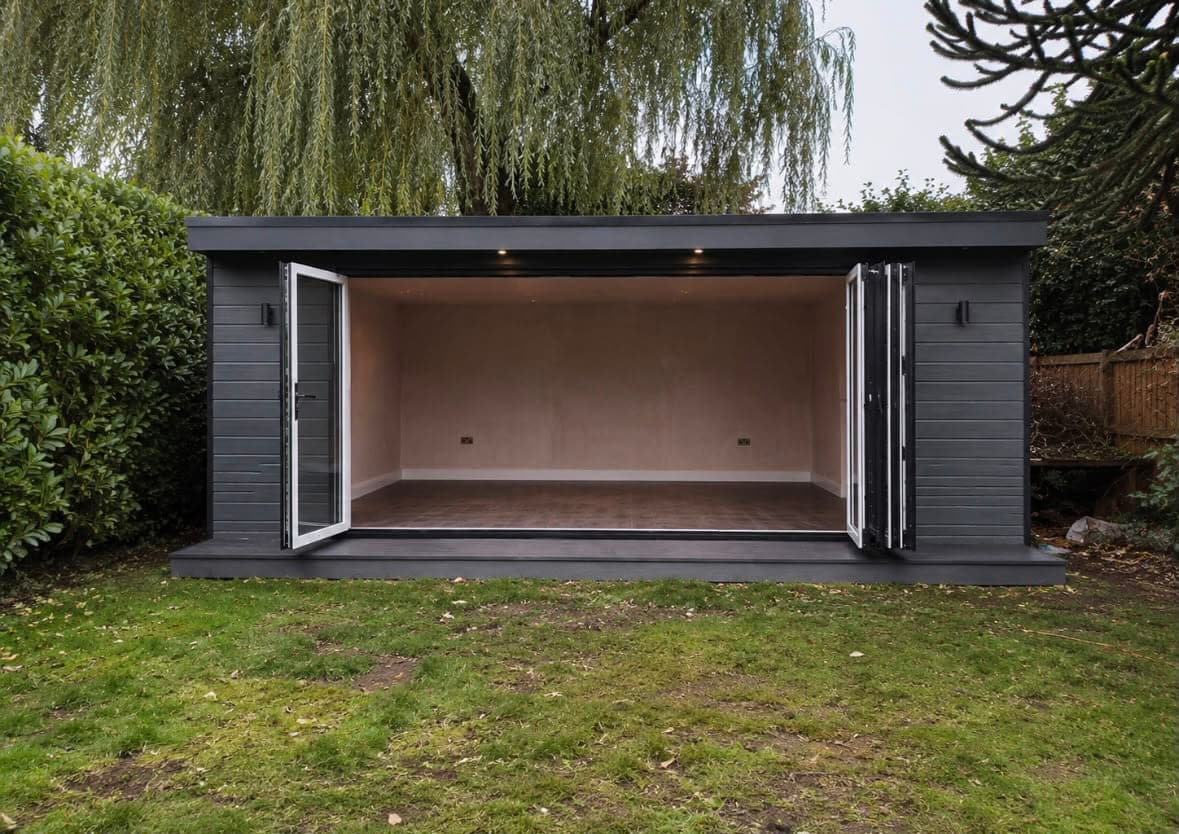
After size, this is where the money goes. Aluminium bi-folds and large sliders are a significant part of the cost of a room, far more than the equivalent run of insulated wall. A room with one set of French doors and a fixed panel is a materially different price to the same room with a full-width bi-fold, even though the floor area is identical.
3. Access
Rarely thought about, and it can move a quote a long way. A garden with a side gate wide enough for a barrow is straightforward. A terraced house where every sheet of ply, every bag of aggregate and every pane of glass goes through the hallway is days of extra labour and a lot of protective covering. It's the single most common reason two apparently identical rooms are quoted differently.
4. Ground conditions
A flat, firm lawn is the easy case. A slope, soft or waterlogged ground, tree roots, or an old concrete base that has to come out all add to the groundwork. We generally use an adjustable screw-pile or pedestal base, which copes with unevenness far better than a poured slab and makes much less mess, but a serious slope is still more work than a level plot.
5. Specification
Within the same footprint, the choices that matter:
- Cladding, western red cedar, which silvers over time, versus a painted composite that stays as it is. Different costs and different maintenance.
- Insulation depth, how well it holds temperature, which is the difference between a room you use in February and one you don't.
- Internal finish, plastered, decorated and floored, versus handed over as a lined shell. This is the gap hiding inside a lot of cheap quotes.
- Electrics, how many sockets, what lighting, and how far the run is from the consumer unit in the house.
- Heating and cooling, an electric panel heater is one thing, an air-conditioning unit that also heats is another.
6. What goes around it
Decking, a path to the back door, moving a shed, taking out a tree, turfing afterwards. None of it is the room itself, all of it affects the final invoice, and it's worth deciding up front whether it's in scope.
What cheap quotes tend to leave out
If one quote is a lot lower than the others, it's usually one of these rather than a genuine bargain:
- No internal finish. You get a lined shell and find out afterwards that plastering, decorating and flooring is another job.
- Electrics excluded, or "customer to arrange". Running a new circuit to a garden building is notifiable work and needs certifying, see our planning guide.
- Base not included, or priced as a provisional sum that moves once someone digs.
- Thin insulation. Cheap to leave out, and the reason a lot of garden rooms are unusable for five months of the year.
- Waste and spoil removal. Groundwork produces a surprising amount of it.
- A deposit far above what's reasonable. Be careful with anyone wanting most of the money before materials are on site.
How we quote
A free site visit, then a written, itemised quote: what's included, what isn't, and what it costs. It doesn't move afterwards unless you change something, and if we spot something on site that changes the number, you hear it then, not halfway through the build.
We'll also tell you when what you've asked for isn't the right call. That's usually cheaper for you, and it's the reason most of our work comes by recommendation.
Common questions
On cost and value
Why don't you publish prices?
Because the honest answer depends on your garden. Size, glazing, access and ground conditions move the figure enormously, a room on a flat lawn with a wide side gate is a very different job to the same room behind a terrace with everything carried through the house. A published 'from' price would be accurate for about one garden in ten and misleading for the rest.
What's the biggest thing that changes the price?
Size first, then glazing. Bi-folds and large sliders cost far more than the equivalent run of insulated wall, so two rooms with identical floor areas can be quite different prices. After that it's access and ground conditions, both of which are about labour rather than materials.
Is a bigger room much more expensive?
Less than you'd think, proportionally. The base, the doors and the setup cost roughly the same whether the room is 3m or 5m wide, so the extra metre is usually cheaper per square metre than the first one. If you're torn between two sizes, the larger is often better value, and almost nobody tells us afterwards that they wish they'd gone smaller.
Does the quote include the base and the electrics?
Ours does, and it's itemised so you can see it. Worth checking on any quote you compare it against, a base priced as a provisional sum, or electrics left as 'customer to arrange', is one of the most common reasons a cheap quote stops being cheap.
Will the price change once you start?
Not unless you change something. If we spot something on site that affects the figure, you hear about it before we start rather than halfway through. That's the point of coming out and looking properly before quoting.
Do you ask for a deposit?
Yes, and it's set out in the quote along with the payment stages. Be wary of anyone wanting the bulk of the money up front before materials are anywhere near your garden.
Free site visit
Get a number for your garden
Free site visit, then a written, itemised quote. No obligation, and no pressure if it turns out not to be for you.
Covering the North West. Site visits and calls, seven days, including evenings, so you don't have to book time off.